
A Summer Holiday
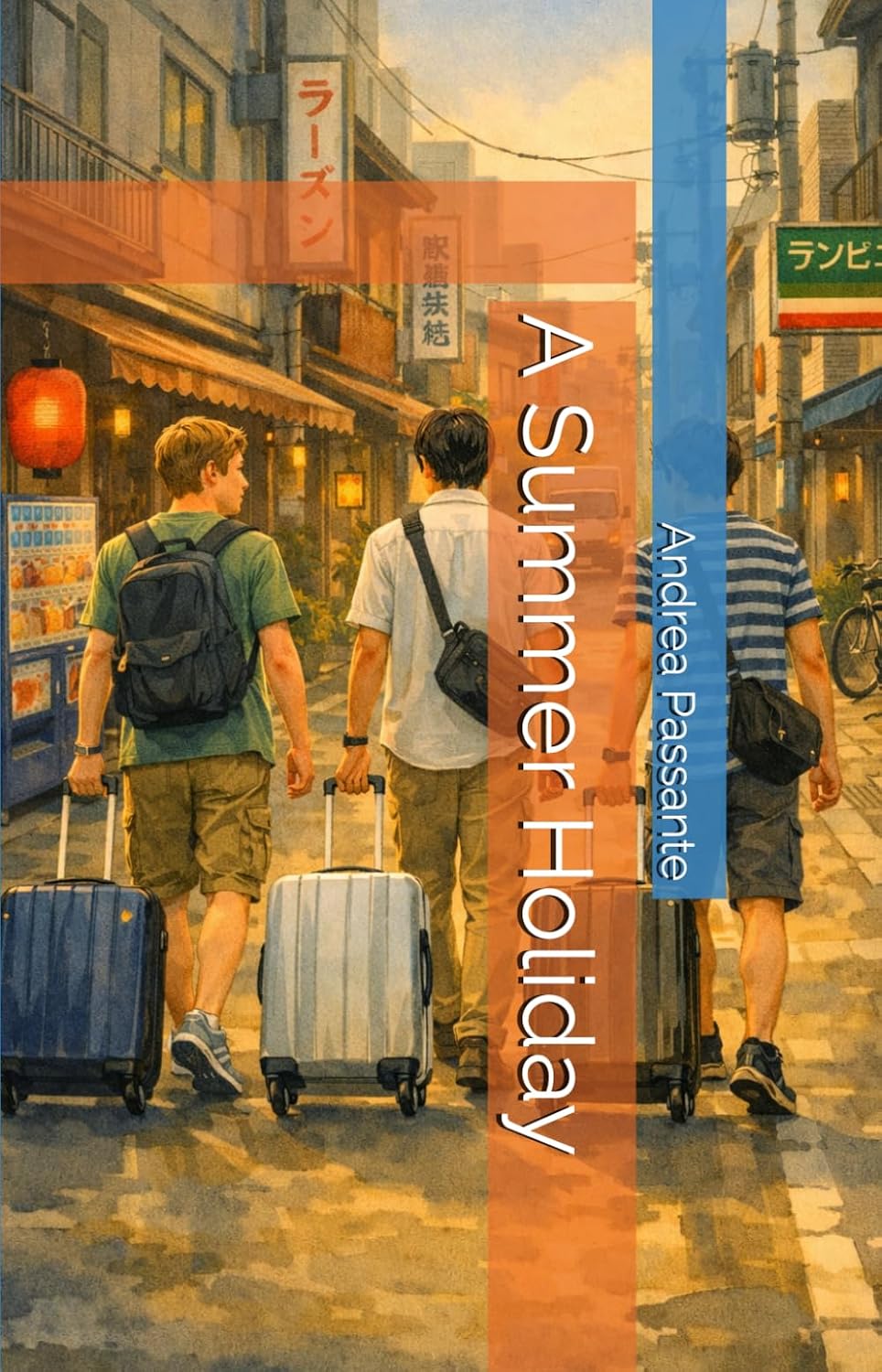
Three friends. One itinerary that survives about four days. A country they were sure they already understood.
Julien, Patrick, Damiano, and Daniel have been planning this trip for months - three weeks across Japan, courtesy of a carefully built, laminated, backed-up-in-triplicate itinerary. Then Patrick, the one who planned half of it, breaks his leg three weeks before departure. The other three go anyway, because that was always the deal.
What follows is nothing like the plan. A wrong train strands them somewhere they never meant to go - and shows them something they'd have missed entirely if everything had gone right. A hotel quietly turns them out over a complaint that was never really about them. A martial arts "experience" turns out to be pure theatre for tourists, while the real thing finds them completely by accident, a few chapters later, in a gym that smells of varnish and effort. A Facebook group turns out to be Damiano's not-so-secret weapon. And somewhere along the way, three friends who thought they knew Japan well enough discover that they'd barely scratched the surface.
The itinerary itself becomes a kind of character in its own right - printed, laminated, backed up, and steadily wrecked, cut down, and rebuilt from a hotel room floor as the trip refuses to cooperate with it. By the time it's abandoned outright somewhere around Osaka, it's less a plan than a souvenir: a record of everything that didn't happen, kept anyway.
Between the chaos, the book quietly builds its own second story, told in fragments - captions and comments posted back to the friends' university travel society account, and read, faithfully, by one person who isn't there. Back home, propped up on a sofa with his leg in a cast, Patrick follows every disaster in real time, one Instagram post at a time - closer to the trip, in some ways, than the three of them travelling through it. His comments thread through the whole book: teasing, encouraging, occasionally landing somewhere more honest than any of them expected.
By the time they land back in England, exhausted and several days behind their own itinerary, there's only one question left to answer.
So - how was it?
Reading level
| Dimension | Assessment |
|---|---|
| Sentence structure | B1+/B2 |
| Core vocabulary | B1/B1+ |
| Idiom & colloquial English | B2 |
| Figurative & abstract language | B2 |
| Cultural references | B2 |
| Irony & humour | B2 |
| Subtext & inference | B1+/B2 |
| Supported classroom use | B1 |
| Independent reading | B2 |
Why two levels? In the classroom, teacher guidance, discussion, glossaries and chapter materials provide support for more demanding idiomatic language, cultural references, figurative expression and implied meaning. Independent readers need to handle those elements without scaffolding, so a higher reading level is recommended.